Unlock This Lesson for Free
Enter your email and the full lesson unlocks instantly. We'll also send you study tips to go with it.
No spam. Unsubscribe anytime.
✓ Unlocked! Scroll down to read your lesson.
Introduction to Aviation
On December 17, 1903, Orville Wright climbed into a flimsy wooden biplane on a windswept beach in Kitty Hawk, North Carolina, and did something no human being had ever done before: he flew. The flight lasted just 12 seconds and covered 120 feet. That's shorter than the wingspan of a modern Boeing 737. But within 66 years of that moment, we were landing on the moon. Everything in aviation (the jets, the GPS, the global travel industry) traces back to those 12 seconds.
So what actually keeps an aircraft in the air? There are four forces acting on every aircraft at every moment of flight: lift, weight, thrust, and drag. Think of them as two tug-of-war matches happening at the same time. Lift pulls the plane up; weight (gravity) pulls it down. Thrust pushes it forward; drag (air resistance) pushes it back. When lift beats weight and thrust beats drag, you fly. When they fall out of balance, something has to change. As a pilot, your job is to manage that balance constantly.
To do that, you need information. You need to know how fast you're going, how high you are, which way you're pointing, and whether you're climbing or descending. That's exactly what the six instruments in front of you are for. Pilots call them the "six-pack", because they sit together in two rows of three on the instrument panel. They are your eyes on the invisible forces keeping you airborne. In this lesson, you'll understand what each one does and, more importantly, why it matters.
The Pitot-Static System
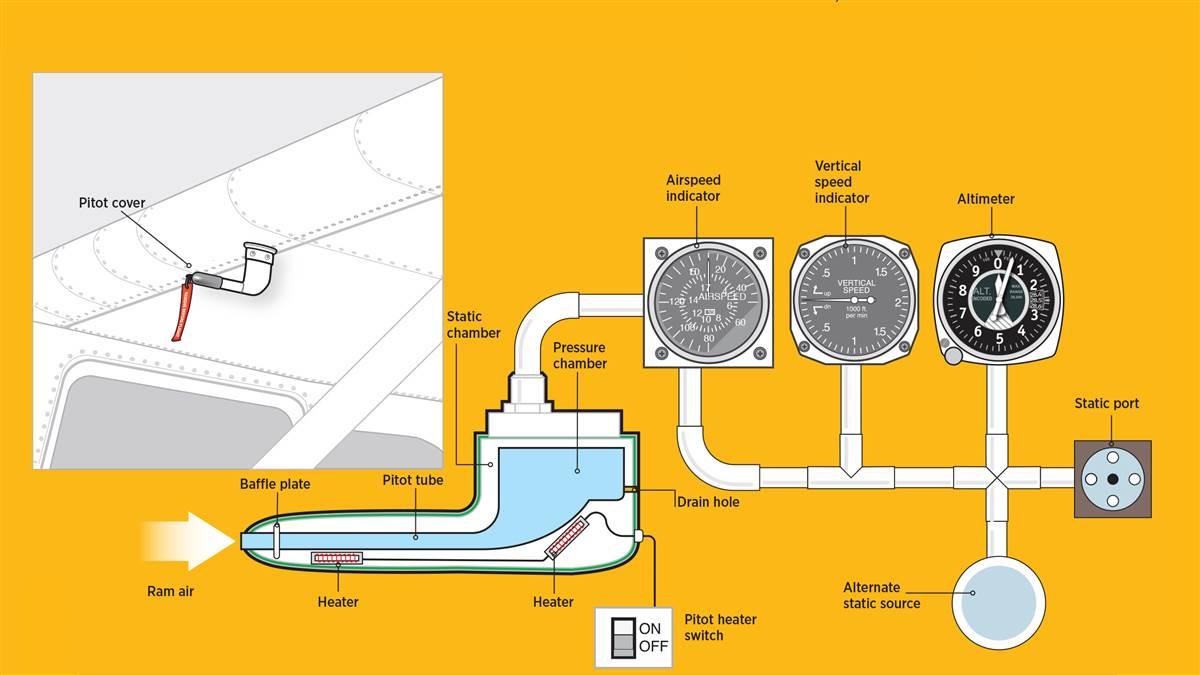
The pitot-static system: two pressure sources, three instruments.
Have you ever stuck your hand out a car window at highway speed? The faster the car goes, the harder the air pushes against your palm. That sensation is real air pressure, and it's the exact principle your airspeed indicator uses to tell you how fast you're flying. The faster the aircraft moves, the harder the air pushes into a small forward-facing probe on the wing called the pitot tube. The instrument reads that pressure and converts it into a speed readout in the cockpit.
But there's a second type of pressure involved: the weight of the atmosphere pressing down from above. This is called static pressure, and it changes with altitude. Think about opening a bag of chips on a mountain. The bag puffs up because there's less air pressure outside pressing against it. The higher you go, the thinner the air, and the lower the static pressure. Your altimeter reads that drop in pressure and translates it into an altitude reading. It's not measuring height directly. It's measuring how thin the air is and inferring how high you must be.
The vertical speed indicator (VSI) works off the same principle, but instead of asking "how much pressure is there right now," it asks "how fast is the pressure changing?" If you're climbing steeply, the pressure drops fast. If you're in a gentle climb, it drops slowly. The VSI shows that rate of change in feet per minute, so you always know whether your altitude is holding, rising, or falling.
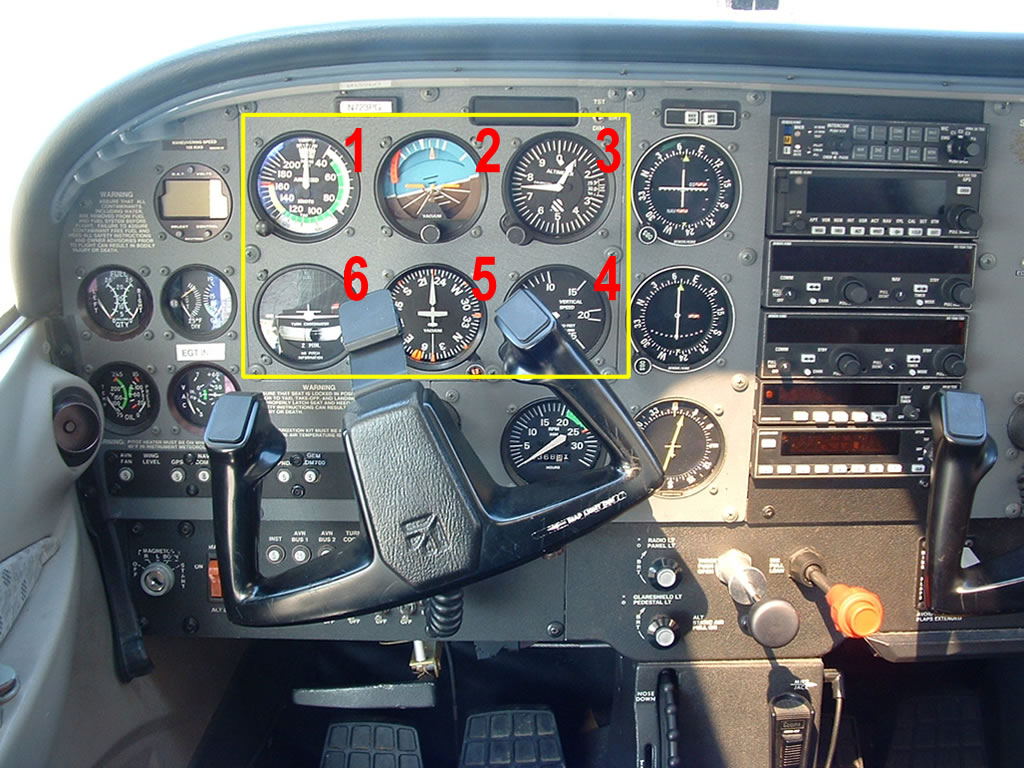
The six-pack in a Cessna 172. The three left instruments use air pressure; the three right use gyroscopes.
All Six Instruments, Simply Explained
- Airspeed Indicator: tells you how fast you're moving through the air. Uses the pitot tube. Too slow and the wings stop generating lift; too fast and the aircraft can be overstressed.
- Altimeter: tells you how high you are. Uses static pressure. Essential for staying clear of terrain and following air traffic rules.
- Attitude Indicator: shows whether the nose is pointing up or down and whether the wings are level. This is the instrument you rely on most when you can't see the horizon (flying through clouds, at night, in haze).
- Heading Indicator: tells you which direction you're flying (North, South, East, West, and everything in between). Your compass in the cockpit.
- Vertical Speed Indicator (VSI): tells you how quickly you're climbing or descending, in feet per minute. Helps you make smooth, controlled altitude changes.
- Turn Coordinator: tells you if your turn is coordinated, meaning the aircraft is turning cleanly without slipping or skidding sideways. Think of it as the "smoothness check" for your turns.
Air Traffic Control

Every controlled airport has a tower. The controllers inside can see your aircraft on radar at all times.
Imagine a busy highway intersection with no traffic lights, no lanes, and no rules. Cars coming from every direction at different speeds, some merging, some crossing, none of them able to see around corners. That's what airspace would look like without Air Traffic Control. ATC is the system that puts the traffic lights in the sky. Controllers on the ground track every aircraft in their airspace using radar, and they issue instructions to keep everyone separated and moving safely.
As a student pilot, you'll start talking to ATC much sooner than you might expect. And the language matters. Aviation radio has a specific format because clarity in the cockpit can be the difference between a routine flight and a serious incident. You don't call up the tower and say "hey, I'd like to take off please." A proper radio call sounds like this: "Buttonville Tower, Cessna Golf Foxtrot Hotel, holding short of Runway 33, ready for departure, VFR to the north." In one sentence you've told them who you're calling, who you are, exactly where you are, and what you want. Controllers handle dozens of aircraft at once. The format exists so they can process your call in two seconds and move on.
Not all airspace works the same way. The sky is divided into classes, like zones with different rules. At a small uncontrolled airfield, there may be no tower at all. Pilots just announce their intentions on a common radio frequency and sort it out themselves. Near a busy regional airport, you need permission before you even enter the airspace. Near a major international airport, the rules are even stricter. You'll learn exactly what each class requires in the full course, but the key idea is this: the busier the airspace, the more structure and communication is required, and ATC is the system that makes it all work.
Lesson Summary
- The Wright brothers flew 12 seconds on December 17, 1903. Every aircraft flying today is built on what they proved possible that day.
- Four forces act on every aircraft: lift and weight fight vertically, thrust and drag fight horizontally. Flying is managing that balance.
- The six-pack gives you a complete picture of your aircraft's state: speed, altitude, direction, attitude, vertical movement, and turn quality.
- Three instruments (airspeed indicator, altimeter, VSI) run on air pressure, not electricity. They need no power, just clean, unobstructed tubes.
- A blocked pitot tube gives false airspeed readings with no warning. Always check it before flight.
- ATC is the system that keeps aircraft separated. It runs on radar and radio communication, and it covers most airspace you'll fly in.
- Radio calls follow a fixed format: who you're calling, who you are, where you are, what you want. Learn this early and it becomes second nature.
Knowledge Check
5 questions based on what you just read. Select an answer to check it instantly.
Two free downloads waiting for you inside the course.
Enroll to unlock both PDFs instantly — yours to keep forever.
Study Guide & Exam Checklist
A structured study guide covering every PPL written exam topic, plus a printable checklist so nothing slips through before test day.
Enroll to DownloadInterview Prep Sheet
Know exactly what flight school interviewers expect. Questions, the right answers, and how to walk in already sounding like a pilot.
Enroll to DownloadMost students walk into their first lesson having read nothing.
You just finished Lesson 1.
15 more lessons are waiting: instruments, weather, airspace, ATC, regulations. The same structure. The same depth. Built so you actually understand it, not just memorize it.
Get the Full Course for $69 →30-day money-back guarantee · Lifetime access · Instant access on enrollment
The full course is hosted on Teachable. Same content, same instructor, dedicated learning platform.